


POCUS in Acute Pulmonary Embolism
Juan V. Resendez MD
Clinical Ultrasound Fellow
LA General Medical Center/USC
POCUS IN ACUTE
PULMONARY EMBOLISM
OVERVIEW
Pulmonary Embolism Review
Pathophysiology of Right Heart Strain
POCUS findings in Acute PE
Advanced Echocardiography in Acute PE
SAVE YOUR SCANS
Patient’s MRN under Patient ID (not under MRN)
Your E Number under Operator
US Faculty or Fellow E/C Number under Referring Physician
WHAT IS A PE?
What is a PE?
Risk factors of PE?
Clinical Presentation?
Physiologic changes in submassive/massive PE?
RISK FACTORS?
HYPERCOAGULABILITY
ENDOTHELIAL
INJURY
VENOUS
STASIS
CLINICAL PRESENTATION?
PATHOPHYSIOLOGY OF RIGHT HEART STRAIN
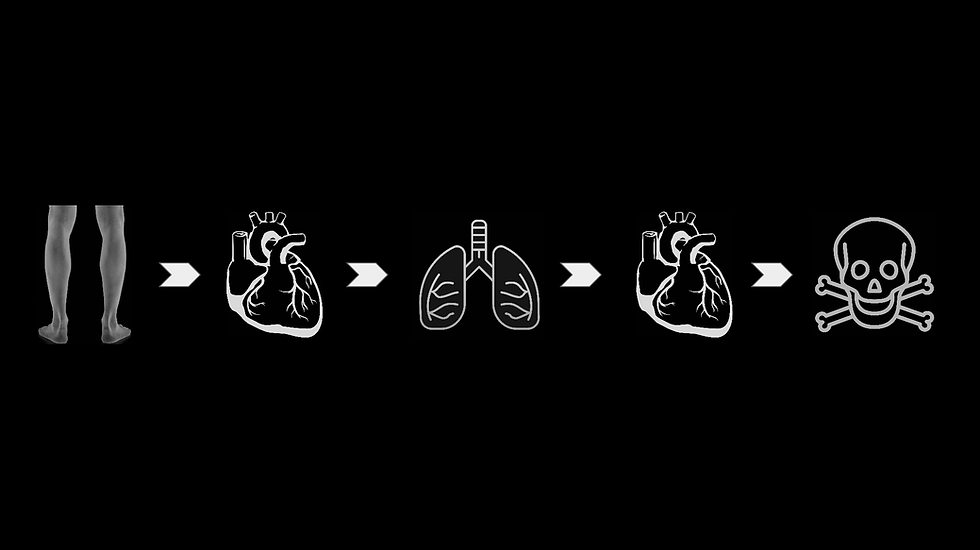
Proximal Arterial Obstruction
Acute Increase in Pulmonary Vascular Resistance
Acute Decrease in Pulmonary Vascular Compliance
Increased RV Afterload
RV sustains higher systolic pressure to maintain output
Thin compliant RV immediately dilates
RV ischemia from increased O2 demand
RV falls off the Starling Curve due to pressure overload
=
RV failure > Decreased LV output > Obstructive Shock
POCUS FINDINGS
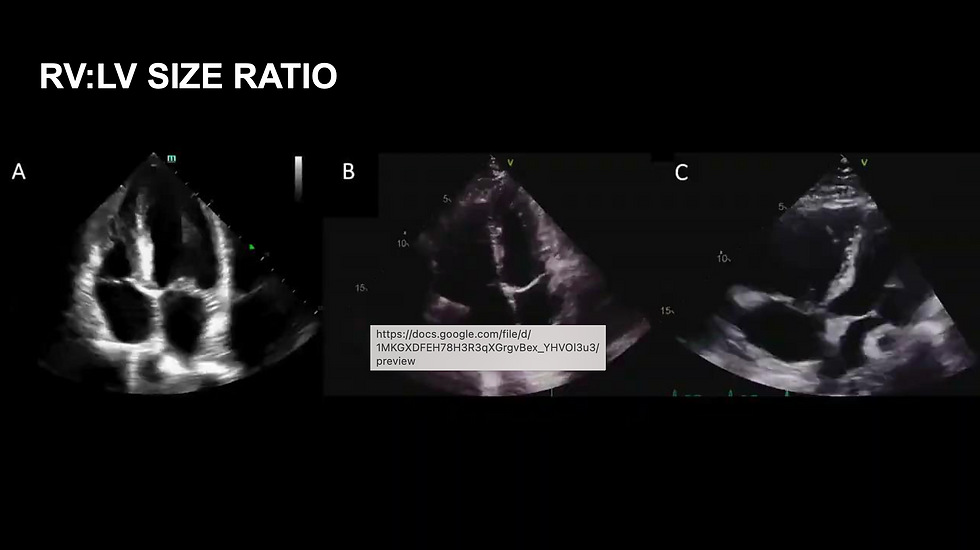
RV:LV SIZE RATIO
A4C / PLAX
RV:LV SIZE RATIO

Normal RV:LV size is 0.6:1
> 0.6:1 is considered RV dilation
Mild 0.6 - 1.0 : 1.0
Moderate 1.1 - 1.5 : 1.0
Severe > 1.5 : 1.0
RV:LV Ratio
RV:LV SIZE RATIO
RV:LV SIZE RATIO
RV Wall Thickness
Measure RV free wall (SX)
Can help determine chronicity of RV dilation
>5 mm suggests hypertrophy, chronic process
ABNORMAL SEPTAL MOTION
PSAX
Normal PSAX view of RV and LV
ABNORMAL SEPTAL MOTION
Septal Bowing, D-Sign
ABNORMAL SEPTAL MOTION
ABNORMAL SEPTAL MOTION
McCONNELL’S SIGN
RV Focused A4C
RV free wall hypokinesis w/ apical sparing
Apex tethered to LV
Ballooning of RV free wall
RV ischemia > RWMA
RV (RCA)
Apex (RCA + LAD)
McCONNELL'S SIGN
McCONNELL'S SIGN
TAPSE
RV Focused A4C
** stress importance of obtaining this
TAPSE
Tricuspid Annular Plane Systolic Excursion
Vertical displacement of lateral TV annulus
Measure of RV systolic function
TAPSE <1.7 cm suggests RV dysfunciton
Muscle fibers that contribute to longitudinal contraction of the RV comprise ~80% of RV EF
IVC VIEW
SX
IVC diameter and respirophasic variation used to estimate CVP/RAP
Thin IVC + >50% collapse (3 mmHg)
Equivocal IVC evaluation (8 mmHg)
Plethoric IVC + <50% collapse (15 mmHg)
ADVANCED
ECHO FINDINGS
What is a PE?
Risk factors of PE?
Clinical Presentation?
TRICUSPID REGURGITATION
A4C, PSAX, RV Inflow View
TRICUSPID REGURGITATION
Regurgitant jets seen on color doppler
TR occurs due to dilation of the RV. As the thin, compliant right ventricular free wall balloons outward in the setting of increased PVR, the TV annulus dilates > decreased coaptation of the tricuspid leaflet > results in regurgitation of flow through the TV.
TRICUSPID REGURGITATION
TRVmax = maximum TR velocity
Used as an indicator for severity of RV strain
Measured using continuous wave doppler through the TR jet
TRVmax > 2.8–2.9 m/s indicates elevated RV systolic and pulmonary artery pressures
Pulmonary Artery Systolic Pressure (PASP) /
Right Ventricular Systolic Pressure (RVSP)
PASP is used as marker of increased pulmonary vascular resistance
PASP > 35 mmHg in absence of chronic pHTN suggests RV strain and dysfunction
Estimated using simplified Bernoulli Equation:
PASP = ΔPRV-RA + RAP
ΔPRV-RA = 4 x TRVmax2
This value then added to RAP (derived from IVC assessment: ~3, 8, 15 mmHg)
PASP = 4 x TRVmax2 + RAP
*assumes no significant RVOT obstruction or pressure gradient across the pulmonic valve
*with the above assumption, PASP = RVSP
Pulmonary Artery Systolic Pressure (PASP) /
Right Ventricular Systolic Pressure (RVSP)
60/60 SIGN
Mention Early Systolic Notching here
60/60 SIGN
Tricuspid Regurgitation Pressure Gradient (TRPG) ≤ 60 mmHg (corresponding to a TRVmax < 3.9 m/s)
TRPG = 4 x TRVmax2
Pulmonary Artery Acceleration Time (PAAT) < 60 ms
If both TRPG and PAAT are < 60 → acute obstructive process (proximal thrombus)
In the setting of chronic pulmonary hypertension, the TRPG can reach > 60 mmHg due to free wall hypertrophy until there is eventual RV failure
60/60 SIGN
Pulmonary Artery Acceleration Time (PAAT)
Time interval from onset of PA ejection to the peak flow velocity across the PV
PAAT shortens with increasing degrees of pulmonary pressures
In acute proximal PE, will see earlier velocity peak due to earlier return of reflected pressure waves in non-compliant pulmonary vasculature
**fix image to first highlight the view we are wanting to obtain
60/60 SIGN
Pulmonary Artery Acceleration Time (PAAT)
Time interval from onset of PA ejection to the peak flow velocity across the PV
PAAT shortens with increasing degrees of pulmonary pressures
In acute proximal PE, will see earlier velocity peak due to earlier return of reflected pressure waves in non-compliant pulmonary vasculature
**fix image to first highlight the view we are wanting to obtain
EARLY SYSTOLIC NOTCHING
RIGHT VENTRICULAR BUBBLE TIME
10cc of agitated NS given as IVP while performing echo
“Bubble Time” = measured amount of time agitated saline was seen in the RV
“Bubble Time” of > 40 sec (Sn 97%, Sp 87%) was predictive of RV dysfunction
RIGHT HEART CLOT IN TRANSIT
A4C, SX4C, PSAX
3 Types of Clot in Transit
Type A: Serpentine, from DVT and highest risk of causing massive PE
Type B: Mural, ovoid and adherent to the right heart walls, less mobile
Type C: Amorphous or ball-shaped, resemble myxomas, less common, freely mobile
THANK YOU

Comments